Business, Wedding Planning Tips, Your Event Career
How to Get Your First Wedding Planning Client
Getting your first wedding planning client comes down to one problem: couples want to see weddings you’ve already planned, and you can’t show any until someone hires you. The way through is to create proof before anyone pays you, then put it where couples and vendors are already looking.
That’s how Aynsley, a QC Event School graduate and owner of Weddings by Aynsley, booked her first clients. Starting with no clients and no portfolio, she interned with planner Ashley Friesen of Ashley Brooke Weddings, completed her training and planned styled shoots, then posted the results on Instagram. “Instagram actually was the reason why I booked my first real clients under my own business,” she says.
QC Event School’s enrollment-reason survey found that 56% of respondents selected starting their own business (2,324 responses, October 2023–September 2026). This guide breaks down a practical five-step approach, drawing on graduate experiences and The Knot’s 2026 study of 10,474 U.S. couples married in 2025. Still setting up your business? Start with How to Start an Event Planning Business.
How to Get Your First Wedding Planning Client: Key Points
- ●Start with one small, specific offer, like day-of coordination or a rehearsal dinner.
- ●Create proof before you’re paid: a documented free wedding, a styled shoot, or assisting an established planner.
- ●Capture every event as evidence: photos, reviews, tags and behind-the-scenes clips.
- ●Get seen where couples and vendors already look, especially during engagement season.
- ●Respond promptly and make the next step clear: responsiveness is among the factors couples report considering when hiring a planner.
How Do New Wedding Planners Get Their First Client?
One practical path to a first wedding planning client is through someone who has already seen your work. That might be a friend whose wedding they coordinated, a follower who saw their styled shoot, or a vendor who worked beside them. The planner builds that proof first, then makes it visible with photos, reviews and social posts.
Couples’ research habits help explain the value of referrals. In The Knot’s 2026 Real Weddings Study of U.S. newlyweds, 71% reported prioritizing advice from friends and family when planning their weddings. That is a planning-resource finding, not a direct measure of how couples choose wedding planners.
Typical first-client channels for new planners include free or discounted events for people they know, styled shoots, assisting an established planner, Instagram and TikTok, local bridal groups, and vendor referrals.
Takeaway: Make your early work visible, even before you have a paid-wedding portfolio.

Case Study: How Aynsley Booked Her First Wedding Planning Clients
Aynsley built proof in three ways before her first booking, then used Instagram to put it in front of couples.
1. Learning on Real Wedding Days
- ●Challenge: She loved weddings but had never run one professionally.
- ●Intervention: She reached out to Ashley Friesen of Ashley Brooke Weddings and arranged her own internship while completing her QC Event School training.
- ●Result: Ashley showed her the documents she used for client meetings, her timeline template and how she runs a wedding day. Ashley still refers clients to Aynsley when her own schedule is full.
2. Creating Proof With Styled Shoots
- ●Challenge: She needed portfolio images and industry connections before real weddings could supply them.
- ●Intervention: She planned styled shoots with venues and local vendors, including a Romantic Renaissance shoot at Bella’s Castle.
- ●Result: Eleven photographers and videographers paid to attend that shoot, and she says her shoots have “definitely resulted in a lot of real booked weddings.”
3. Getting Seen Where Couples Look
- ●Challenge: Proof only works if the right people see it.
- ●Intervention: She posted her work on Instagram and joined local Facebook groups where brides ask for vendor recommendations.
- ●Result: Instagram booked her first real clients under her own business, and it still brings in many of her clients today.
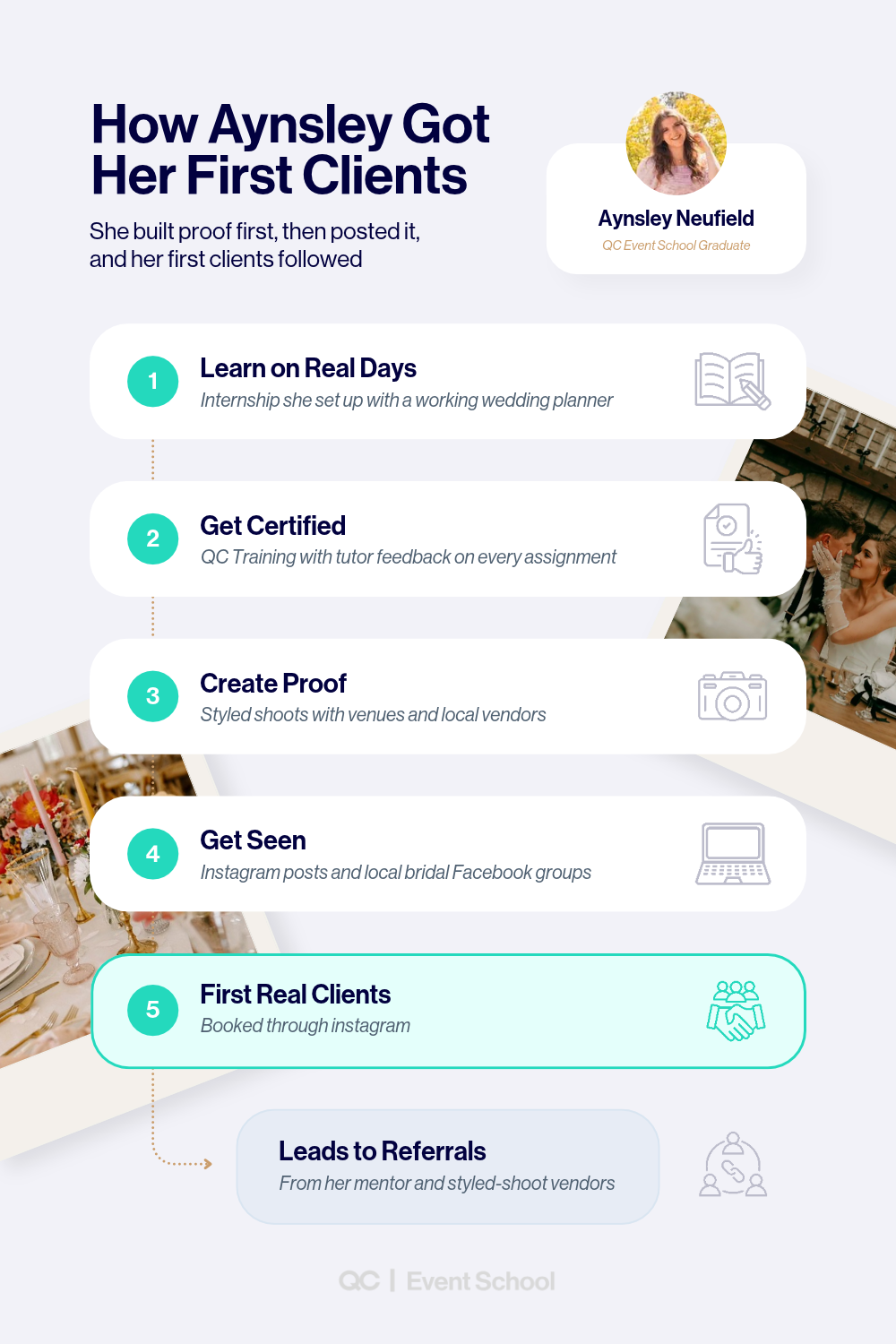
Every step built proof first; Instagram turned that proof into her first bookings.
Which First-Client Channel Fits You?
Aynsley used most of these channels. You don’t need all of them; start with the one or two that match what you already have.
| Channel | What It Needs From You First | Best If You… |
|---|---|---|
| Free or discounted events for people you know | A written agreement and a clear ask (photos, review, tags) | Know engaged couples or party hosts |
| Styled shoots | A concept, a venue and a handful of vendors willing to collaborate | Have no real events to show yet |
| Assisting an established planner | Reliability and a willingness to learn on someone else’s timeline | Want wedding-day experience fast |
| Instagram and TikTok | Real photos and behind-the-scenes clips from the work above | Can post consistently |
| Local bridal Facebook groups | A helpful presence before any pitch | Live in an active wedding market |
| Vendor referrals | Relationships built on shoots or shared events | Have worked alongside local vendors |
I booked my first two weddings in 2025 and am excited to create six more unforgettable celebrations in 2026.
Nichole Zeman, founder of Meraki Events & Design and QC Event School graduate · Explore the Event & Wedding Planning course
Step 1: Start With One Small, Specific Offer
Your first client is taking a risk on you, so give them something small and specific to say yes to. “Full-service wedding planning” asks a stranger to trust you with a year of their life. “I’ll run your wedding day so your family can enjoy it” asks for one day.
Weddings are full of smaller events you can offer first. According to The Knot’s 2026 Real Weddings Study, 71% of weddings now span two to three days. The same study found:
- ●75% of couples host a rehearsal dinner
- ●27% host an after-party
- ●26% host welcome drinks
- ●21% host a day-after brunch
Each one is a contained event a new planner can own. Day-of coordination is another strong first offer, and it puts you on a full wedding day without a year of planning.
Packages, pricing models and contracts are covered in the start-a-business guide.
Step 2: Create Proof Before Anyone Pays You
A portfolio and credible feedback help prospective couples evaluate your work. The Knot advises couples to review portfolios and reviews when choosing a wedding planner. Before your first paid booking, you can begin collecting examples of your skills and feedback from relevant projects.
Run a Free or Discounted Event, in Writing
Free work builds a business only when the exchange is explicit. QC Event School graduate Gabrielle, of Weddings by Gabrielle in Salt Lake City, started this way. She coordinated friends’ weddings at no charge and asked for social media tags and reviews in return.
That online presence led to her first paid client, a bride planning a Salt Lake City wedding from Missouri. “That was my first paid wedding and I will never forget it,” she says.
Agree on these points in writing before the event:
- ●What you’ll do, and what isn’t included
- ●That you can photograph your setup and post it
- ●That they’ll write a review and tag you afterward
- ●That free work is limited to a set number of events before you start charging
📅 Want to see how Aynsley’s portfolio comes together? Read 3 Solid Event Portfolio Examples to Look Up To, which features Weddings by Aynsley.
Plan a Styled Shoot
A styled shoot is a staged event, built for photos, with real vendors. It can demonstrate your design direction, preparation and collaboration, although it is not the same as coordinating a live wedding with a paying client. It also connects you with vendors who may later refer you.
You don’t need a big concept. For one of the shoots she’s proudest of, Aynsley took the venue’s own idea and ran with it, creating something every vendor enjoyed being part of.
Assist an Established Planner
Working someone else’s wedding day shows you how the day really runs. Ask a planner you admire whether you can assist on a few weddings, as Aynsley did. What stayed with her most was how calmly her mentor handled problems, which she says “still runs through my mind every wedding day I have on my own now.”
Use Your Course Work
In QC Event School’s Event & Wedding Planning course, you plan a styled shoot and build a professional portfolio as part of the business unit. Aynsley still structures her client inspiration boards on the project boards she made for the course.
Takeaway: Start with one strong, clearly labeled example of your work; keep building real-event experience and client feedback as opportunities arise.
Step 3: Turn Every Event Into Evidence
An event nobody sees won’t bring in your next client. Capture it while it happens, and ask every vendor involved to share it. When vendors post a shoot or wedding you planned, your work reaches couples who have never heard of you.
Behind-the-scenes clips are worth the extra effort. Gabrielle says about 70% of her inquiries now come from TikTok and Instagram, where she shares behind-the-scenes content from real weddings. That content, she says, has been “priceless for showing couples what it’s actually like to work with me.”
After every event, free or paid, collect:
- ●Photos of your setup, plus permission to use the photographer’s images (and tag them)
- ●A short behind-the-scenes clip from setup or the day itself
- ●A written review on Google, The Knot or Facebook, requested within a week
- ●A one- or two-line testimonial you can quote on your website
- ●Tags from the client and every vendor on the team
Step 4: Get Seen by Couples and Vendors
Be visible in the few places your first client already looks, at the time of year they start looking.
Time It for Engagement Season
December is the most popular month to get engaged, with Christmas Day the top day of the year, according to The Knot’s 2026 Real Weddings Study. Around 40% of proposals happen between Thanksgiving and Valentine’s Day, and nearly 60% of couples start planning within a month of getting engaged.
Have your proof posted and your profiles ready before December, so newly engaged couples find you when they start searching.
Where Couples Are Looking
- ●Instagram and TikTok. Post the proof from Steps 2 and 3, especially behind-the-scenes clips. Instagram booked Aynsley’s first real clients.
- ●Local bridal Facebook groups. Aynsley found brides in local groups where couples ask for vendor recommendations and tips.
- ●Your bio and profiles. Show your training where couples can see it. One QC student booked her first wedding before finishing the course, just by adding her enrollment to her bio (see below).
- ●Friends and family. Tell them about your first offer from Step 1. With 71% of couples prioritizing advice from friends and family, a personal recommendation carries real weight.
I am not even complete with school yet and by placing in my bio that I am enrolled at QC Event School I already have my first wedding booking for this year!
Shaquaila Jacobs, QC Event School student · Explore the Event & Wedding Planning course
Who Refers Couples to Planners
Couples usually choose their venue first. In The Knot’s 2026 study, 83% of couples said choosing the venue was most important to them, and couples tend to focus on it first. Getting to know local venue coordinators can put you in front of couples at the very start of planning.
Other vendors matter too. Aynsley credits styled-shoot collaborations for making her name locally: “Collaborating with other vendors on styled shoots also has gotten my name out there a lot more so I am a known person in the industry.”
Don’t wait to start. Gabrielle’s biggest regret from her early days is holding back: “I felt intimidated by people with more experience than me and I was nervous to put myself out there or go to the networking events. Now I know how welcoming and kind the people in my market are.”
📅 Ready to start networking? Read Event Planner Jobs: How to Network Like a Pro
Step 5: Turn Your First Inquiry Into a Booking
Your first inquiry is where preparation pays off. In The Knot’s 2026 Real Weddings Study, 52% of surveyed couples identified responsiveness among their top deciding factors when hiring a wedding planner, while 50% identified personality.
Those findings describe reported priorities, not a guarantee that quick replies outweigh experience for every couple. Prompt communication and a thoughtful consultation are factors a new planner can control:
- Reply quickly. A prompt, friendly reply with a proposed consultation time shows the responsiveness couples are looking for.
- Run a real consultation. Ask about their date, venue, guest count, budget and the kind of help they want. This is where couples judge your personality, so let it come through.
- Send a clear proposal. Name the service, what’s included, the price and the next step.
- Book it properly. Use a signed contract and collect a deposit. QC Event School students get contract templates and 6 months of free Aisle Planner access for managing clients.
- If they say no, ask why. A short, polite question about what made them choose someone else gives you feedback you can use on the next inquiry.
Expect a long runway for weddings. Couples are engaged for an average of 14 months, according to The Knot’s study, and The Knot advises booking a planner at least 12 months before the wedding.
Takeaway: Your first paid wedding may be a year out, so keep booking smaller events like rehearsal dinners and showers in the meantime.
Why You Haven’t Booked Your First Client Yet
If you’ve been trying with no bookings, the problem usually sits at one stage: getting found, getting inquiries, or turning consultations into bookings. Find that stage and fix it first.
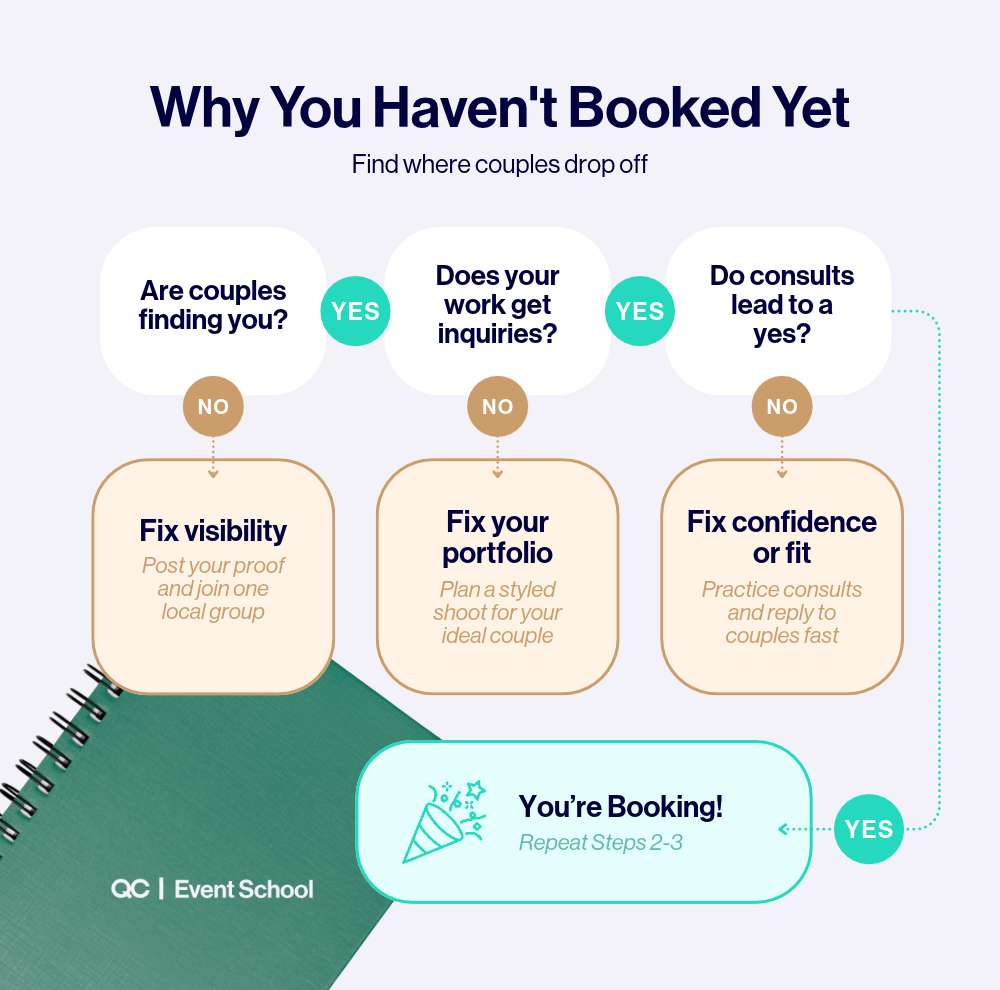
Ask yourself these three questions in order. The first “no” shows you where to focus:
- Can couples and vendors find your work? If not, start with visibility: post your proof on Instagram and TikTok, join a local bridal group, and add your training to your bio (Step 4).
- Is your work turning into inquiries? If not, strengthen your portfolio: add a documented event, a styled shoot or a client review so couples have something to say yes to (Steps 2 and 3).
- Are your consultations turning into bookings? If not, tighten your follow-through: reply quickly, run a real consultation and send a clear proposal (Step 5).
Yes to all three? You’re booking. Keep collecting proof from every event.
If you hesitate to charge, confidence may be part of the challenge. In an internal qualitative review of 125 QC Event School testimonials, confidence was the most frequently coded theme (22 mentions). This describes the testimonials reviewed; it is not a representative estimate of how many students struggle with confidence.
Gabrielle says certification helped her feel ready to launch her business in a crowded market; Aynsley’s perspective is in the FAQ below.
FAQ: Getting Your First Event Planning Client
How do you get your first event planning client with no experience?
Start with proof instead of experience. Run one documented event for someone you know, plan a styled shoot, or assist an established planner, then post the results where couples look. QC Event School graduate Aynsley started with no clients and booked her first real ones through Instagram after building proof this way.
Should your first event planning client be free?
It can be, as long as the terms are in writing. A free or discounted event should earn you photos, a review and tags you can show the next couple. Limit free work to a set number of events before you start charging.
Do you need a portfolio before your first wedding planning client?
You don’t need a large wedding portfolio to start introducing your services. Clearly labeled styled shoots, assisted events and relevant coursework can show your approach, but they shouldn’t be presented as paid-client weddings. As you work on real events, add permission-cleared photographs and genuine client reviews.
Do couples care if a new wedding planner has experience?
Experience can matter, but it’s not the only consideration. The Knot’s 2026 Real Weddings Study reports that 52% of surveyed couples identified responsiveness among their top factors when choosing a planner, and 50% identified personality. New planners can demonstrate professionalism through a prompt response, relevant work samples and a clear consultation.
How long does it take to get your first event planning client?
It depends on your market, your network and the events you offer. Weddings have a long runway: couples are engaged for an average of 14 months, and The Knot advises booking a planner at least 12 months ahead. Smaller events like rehearsal dinners can bridge the gap. Some QC Event School students book their first client while still enrolled, and graduate Nichole Zeman booked her first two weddings in 2025.
Do you need certification to get wedding planning clients?
No. The BLS describes event planner certifications as voluntary and not required. Certification still helps you stand out and charge with confidence. As Aynsley puts it: “My certification provides me that leg up and gives me confidence to charge what I am charging because I’m a valuable asset to anyone’s wedding.”
Can you get your first client while still taking a course?
Yes. QC Event School’s Event & Wedding Planning course is self-paced and online, so students can take on real events while they study. Vivian Akhabue signed her first client halfway through the course.
How is getting a wedding planner job different from booking your first client?
Getting hired by an employer and booking a client for your own business are different goals. For employment, focus on relevant experience through venue roles, assisting planners and internships. For your first business client, focus on a defined service, examples of your work and referral relationships. See our wedding planner career guide for the employment route.
Want corporate clients instead of weddings?
Corporate-client acquisition involves a different audience and referral network. For that topic, see How to Find Clients as a Corporate Event Planner, including LinkedIn and local business networks.
Your Next Step: From Trained to Booked
Your first client is closer than it feels once you have proof, visibility and a clear first offer. Aynsley’s advice to anyone still deciding is simple: “Just start! The biggest step is the first one.”
Your shortlist:
- ●Write your first offer in one sentence (Step 1)
- ●Book one documented free, discounted or assisted event (Step 2)
- ●Collect photos, a review and tags afterward (Step 3)
- ●Join one local group and introduce yourself to three vendors (Step 4)
- ●Prepare your consultation questions and a proposal template (Step 5)
Get Certified and Ready for Your First Client
QC Event School’s Event & Wedding Planning course is fully online and self-paced, with up to a year to finish, and covers every step in this guide.
From styled-shoot portfolios to client consultations, it includes templates and contracts you can use with real clients. Graduates earn the ILEA-approved IEWP™ designation, and every enrollment comes with a 14-day money-back guarantee.
Related Reading
- ●How to Start an Event Planning Business (Step-by-Step Guide): business plans, registration, startup costs and pricing
- ●How to Get Clients as an Event Planner: growing past your first few clients
- ●Getting the Clients You Really Want: once you can be choosier
- ●How to Market Your Event Planning Services to Past Clients: turning first clients into repeat clients
Sources
- The Knot, Real Weddings Study 2026 (Data Read-Out PDF), 10,474 U.S. couples married in 2025, published February 2026
- The Knot, How to Hire a Wedding Planner, From Research to Booking, updated May 18, 2026
- U.S. Bureau of Labor Statistics, Occupational Outlook Handbook: Meeting, Convention, and Event Planners, last modified August 27, 2026
- QC Event School New Student Survey, 2,324 responses to the enrollment-reason question, October 2023 to September 2026 (first-party data)
- QC Event School graduate questionnaires: Aynsley (Weddings by Aynsley, @weddingsbyaynsley) and Gabrielle (Weddings by Gabrielle, @weddingsbygab), 2026, first-party interviews
- QC Event School student testimonials: Nichole Zeman, Shaquaila Jacobs, Vivian Akhabue; theme analysis of 125 QC Event School testimonials (first-party data)