
Business, Education, From the Experts, Your Event Career
Do You Need a Certification to Become an Event Planner?
No. You don’t need an event planning certification to work as an event or wedding planner in the U.S. The Bureau of Labor Statistics describes professional certifications for this occupation as voluntary (BLS, 2026).
But professional training can help you develop the skills, confidence and credibility to begin your career. QC Event School’s certification demonstrates that you’ve completed structured, tutor-assessed coursework built around real event planning situations.
Here’s how course credentials compare with experience-based certifications, when certification is worth pursuing, and what QC’s training includes.
Key Points
- ●You don’t need a certification to work as an event planner in the U.S.
- ●QC Event School’s certification recognizes completed professional training and assessed practical coursework.
- ●Credentials such as the CMP and CSEP are generally pursued after gaining industry experience.
Do You Have to Be Certified to Be an Event Planner?
No. There is no government-issued event planner license, and certifications come from schools and professional organizations, not the government (Wolters Kluwer). The BLS also describes planner certifications as voluntary (BLS, 2026).
The licenses and permits that do apply belong to your business and your events; we break those down in Do You Need a License to Be an Event Planner?
Qualifications still matter in different ways depending on the work:
| Setting | Is a Credential Required? | What Actually Applies |
|---|---|---|
| Your own planning business (weddings, parties, day-of coordination) | No | Clients judge you on your portfolio, reviews, contract and how you communicate. |
| Salaried planning jobs (hotels, venues, companies) | Set by each employer | In 2025, 80.7% of planner jobs required prior work experience and 53.9% required a bachelor’s degree (BLS Occupational Requirements Survey, 2025). |
| Running the business and the event | Rules apply to the business, not you | Business registration, sales tax, insurance, venue or park permits and alcohol service. These vary by state, county and city. |
Outside the U.S., rules differ by country and province, so check with your local small-business authority before you take paid work.
Want to learn more?
See the registration, insurance and setup steps in How to Start an Event Planning Business in 5 Steps.

What’s the Difference Between a Course Certification and an Experience-Based Certification?
A course credential recognizes structured training and assessment. Industry certifications such as the CMP and CSEP evaluate professional knowledge and experience against an organization’s own eligibility standards. They serve different purposes, often at different career stages.
The Institute for Credentialing Excellence (I.C.E.) distinguishes assessment-based certificate programs, which teach and assess specific learning outcomes, from professional certification programs, which assess knowledge or competencies independently of one training course. The distinction explains why the two credential types should not be treated as interchangeable (I.C.E.).
Here’s how the two compare side by side:
| Course Certification | Experience-Based Certification | |
|---|---|---|
| Issued by | A school or training provider | An industry organization |
| Experience needed to start | None | Varies by credential; typically professional experience |
| How you earn it | Complete coursework and graded assignments | Meet the issuer’s requirements and pass its assessment |
| What it demonstrates | You completed assessed professional training | You met the credentialing body’s knowledge and competency requirements |
| Renewal | Varies; QC Event School’s never expires | Depends on the certification body’s renewal rules |
| Examples | QC Event School’s IEWP | CMP (Events Industry Council): 36 months of full-time industry work, or 24 with an event management or hospitality degree. CSEP (ILEA): five years, or fewer with supporting documents ILEA reviews |
CMP and CSEP are not required to plan weddings or social events. For beginners, QC’s course certification provides an accessible way to develop practical skills and earn a professional designation while building experience.
What Does a QC Event School Certification Include?
QC Event School students complete practical, tutor-assessed assignments and earn professional designations that recognize their training. QC describes its professional event certifications as ILEA-approved, with credentials valid for life and no renewal fees.
The course projects, feedback and business training help students build the foundation for their first opportunities. See the full list of designations and coursework below.
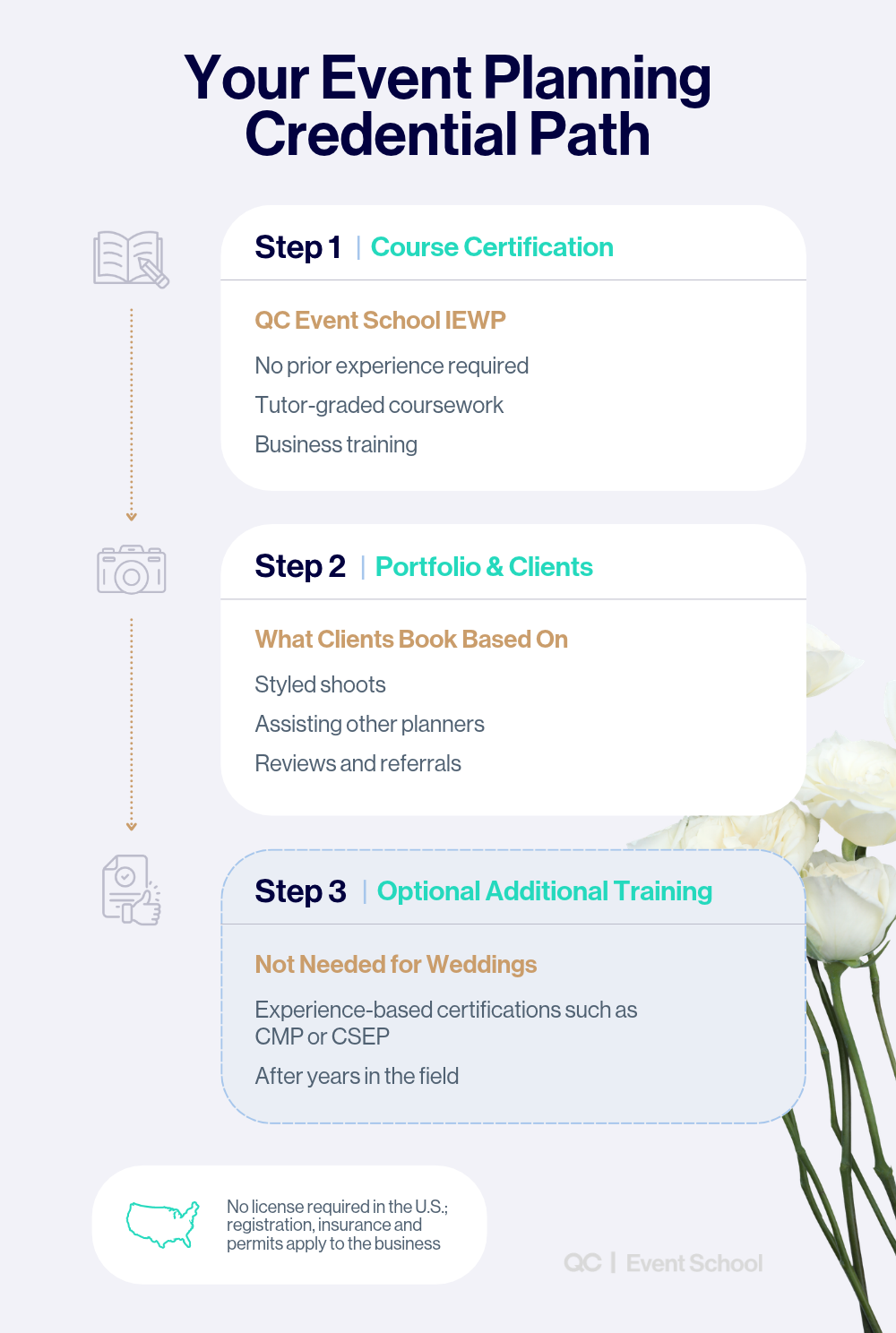
Takeaway: Professional training helps you build the skills and portfolio that clients can evaluate alongside your credentials and reviews.
Can Beginners Take an Event Planning Certification Course?
Yes. QC Event School’s foundation courses are designed for beginners and have no prior-experience requirement. Industry certifications such as CMP and CSEP typically have additional eligibility requirements.
A strong beginner course should require you to apply what you’ve learned, not simply watch lessons. Look for:
- ●Graded assignments with individual feedback from working event planners
- ●Business training on pricing, contracts and marketing, if you plan to freelance
- ●A portfolio piece, such as a styled shoot, you can show clients
- ●A clear statement of what the credential is and who approves it
- ●Clear information about credential validity and renewal
Red flags to watch for:
- ●The program presents a training credential as a government-issued license.
- ●Fees for earning or receiving the credential aren’t disclosed upfront.
- ●There’s no graded work, only videos and an auto-scored quiz.
- ●Tutors’ or instructors’ industry experience is unclear.
- ●Course requirements or refund terms aren’t available before enrollment.
QC’s professional training includes tutor-graded assignments, business training and practical projects, including a styled shoot in Event & Wedding Planning. QC describes its professional event certifications as ILEA-approved, and graduates can use their earned credentials without renewal fees. Courses are self-paced, with up to a year to finish.
What Do Clients and Employers Look for Besides a Certification?
Clients want evidence of what you can deliver, including a portfolio, reviews and referrals. Employers also consider training and experience.
Alyssa Perna, Principal Owner of Experience Events and a QC Event School tutor, has more than a decade of event operations experience spanning multinational conferences, trade shows, festivals and fundraisers. Drawing on her experience hiring event coordinators and assistants, she says: “I look for a combination of education, experience, and demonstrated competence.”
She looks for practical knowledge of logistics, production and event execution, whether gained through paid or volunteer work. For applicants who lack hands-on experience, solid foundational training can help demonstrate readiness, especially when paired with initiative and a willingness to learn.
If someone has limited hands-on experience, I want to feel confident in their foundational knowledge of the events industry through their education, training, or professional certifications.
Alyssa Perna, Principal Owner of Experience Events; QC Event School Tutor
For aspiring business owners, these QC graduates show how professional training can become visible work, stronger portfolios, and paying clients:
| Graduate | Starting Point | What She Did | Result |
|---|---|---|---|
| Nichole Zeman, Meraki Events & Designs | No professional event experience; previously worked full-time at U.S. Steel | Earned her QC certification, shadowed working planners at events, and reached out directly to potential clients | Her first cold call became her first Meraki wedding. She built her own event planning business after training and shadowing working planners |
| Gabrielle, Weddings by Gabrielle, Salt Lake City | Hospitality and corporate event experience, but no wedding clients | Coordinated friends’ weddings for free in exchange for social media tags and reviews | That online presence brought her first paid client, a Missouri bride planning a Salt Lake City wedding. In her fifth year, about 70% of her inquiries come from TikTok and Instagram |
| Aynsley Neufeld, Weddings by Aynsley | Wanted to plan weddings under her own name | Interned with Ashley Friesen of Ashley Brooke Weddings while earning her QC certifications, then promoted her work on Instagram and ran styled shoots with local vendors | Instagram brought her first clients, styled shoots led to booked weddings, and her mentor refers clients she can’t take on |
For salaried roles, employers expect experience and train on the job: 80.7% of planner jobs required prior work experience in 2025, and 86.6% included on-the-job training (BLS ORS, 2025). The BLS points to entry routes such as hotel and convention center jobs, coordinating volunteer events and shadowing professionals (BLS, 2026).
That’s where training helps you get a foot in the door. Lily Gavio had no event experience when she enrolled in QC’s Event & Wedding Planning course. After graduating, she interviewed with an event planning business and was offered a position assisting a planner, a role she took to gain hands-on experience.
Want to learn more?
See how graduates landed their first paying clients in How to Get Your First Wedding Planning Client

When Is Event Planning Certification Worth It?
Professional certification training can be especially worthwhile when you need foundational skills, feedback, a portfolio project and a credential that reflects assessed coursework. Experienced planners may benefit more from a targeted specialty than a beginner course.
| Your Situation | Is a Course Certification Worth It? | Where to Start |
|---|---|---|
| New to events, want to start a planning business | Yes: you get skills, business training and a first portfolio piece | Event & Wedding Planning |
| New to events, want to be hired | Yes, alongside hands-on experience employers screen for | A foundation course in your target area |
| Working in hospitality, admin or retail and adding events to your role | Yes, for focused training you can use right away | Corporate Event Planning |
| Already an experienced, booked planner | Only for a new specialty or structured business training | A specialty course, such as Luxury or Destination Wedding Planning |
| Planning only your own wedding | Probably not; a single event doesn’t need a credential | Free planning resources on the QC blog |
Will a Certification Let You Charge More?
There’s no reliable evidence that an event planning certification automatically raises your rates, and BLS wage figures don’t distinguish pay by credential. Training can help you understand pricing, including time spent coordinating vendors, timelines and client communications.
Takeaway: Your rates also depend on your market, experience and portfolio.
Weighing a course against a college program?
Read Event Planner Certification or Event Planner Degree? For the full path from training to your first event, see How to Become an Event Planner: The Ultimate Guide
Quick Decision Guide: Next Steps for Employees vs. Freelancers
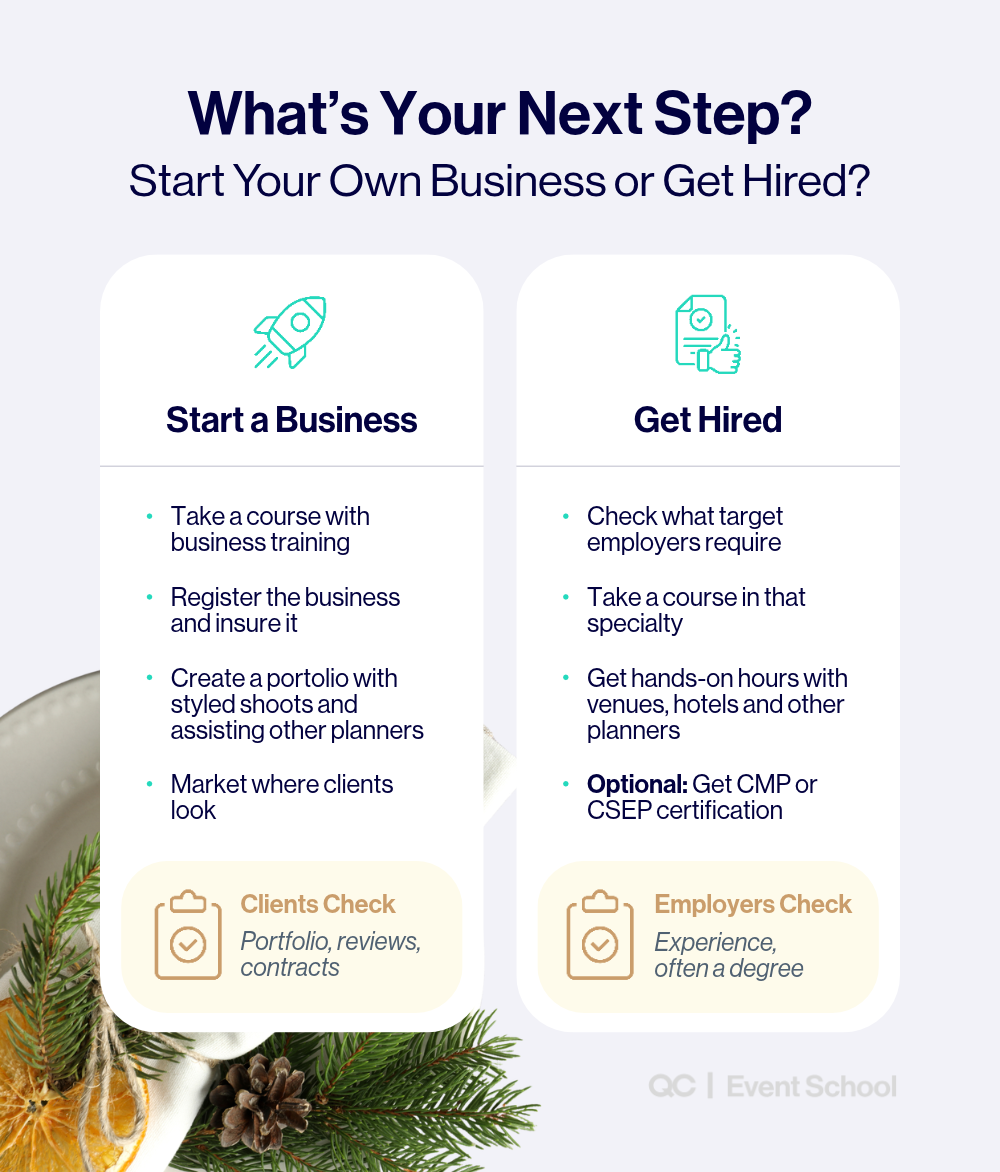
If you want to start your own business:
- Take a foundation course with business training, so you finish with packages, contracts and a portfolio piece.
- Register your business and get insurance where you’ll operate.
- Build proof: assist other planners, run a styled shoot and collect reviews.
- Show up where clients look, and describe your credential accurately on your website.
If you want to be hired:
- Check job postings in your target setting and note whether they ask for a degree, experience or both.
- Take a course in that specialty so your résumé shows structured training.
- Get hands-on hours: venue, hotel or assistant roles, or volunteer events.
- Grow into senior roles; experience-based certifications like the CMP or CSEP become options after years in the field.
Alyssa’s recommendation after training is to volunteer with a nonprofit that produces events and take ownership of even a small part of the process. This gives beginners a chance to apply their skills, learn from experienced teams and build real-world confidence. She also encourages ongoing learning through industry organizations and educational resources.
QC Event School Certifications: Designations and Coursework
You earn a professional designation to use after your name through practical, tutor-assessed online training. QC Event School describes its professional event certifications as approved by the International Live Events Association (ILEA), with course content meeting ILEA’s standards.
QC issues its own certifications; ILEA does not award the QC designation. QC certifications are valid for life, with no renewal fees (QC Event School website).
QC’s professional planning and decor courses award designations such as:
| Foundation Course | Designation You Earn |
|---|---|
| Event & Wedding Planning | International Event and Wedding Planning Professional (IEWP) |
| Event Planning | International Event Planning Professional (IEPP) |
| Wedding Planning | International Wedding Planning Professional (IWPP) |
| Corporate Event Planning | International Corporate Event Planning Professional (ICPP) |
| Event Decor | International Event Decorating Professional (IEDP) |
How You Earn It
- ●Coursework built for beginners. Foundation courses require no prior event training or experience.
- ●Graded, real-world assignments. You complete scenario-based projects, such as budgets, timelines and vendor plans, with personalized feedback from working event professionals. Alyssa says she sees students become more thoughtful and confident in how they approach practical problems as their industry knowledge grows.
- ●Tutors who work in the industry. Alyssa Perna brings a decade of experience producing diverse events, while tutor Heather Hawes has over 20 years in event management.
- ●Business training. Courses include training on branding, marketing and launching a planning business. The Event & Wedding Planning course also walks you through planning a styled shoot to build your portfolio.
- ●Recognition for strong work. Students automatically receive an Award of Excellence for any unit graded A or higher.
What It Is, and What It Isn’t
| A QC Certification Is | A QC Certification Isn’t |
|---|---|
| A professional designation earned through assessed QC coursework | A government license (none is required for planners) |
| ILEA-approved, as described on QC’s website | A college degree |
| Valid for life, with no renewal fees (QC FAQ) | Proof of years on the job, which only experience provides |
| Backed by a school with an A+ Better Business Bureau rating since 2004 | A replacement for a portfolio and client reviews |
One of the most valuable skills I’ve seen students develop is confidence in what they’ve learned and their ability to put that knowledge into practice.
FAQs About Event Planning Certification
Do wedding planners need a certification?
No. No license or certification is required to plan weddings in the U.S. Training still helps with the hardest parts of the job: Gabrielle says tutor feedback on her QC assignments helped her handle family dynamics and sensitive wedding-day situations.
Is QC Event School’s certification approved by ILEA?
Yes. QC Event School describes its professional event certifications as ILEA-approved, including the Event & Wedding Planning (IEWP) certification. QC awards these credentials upon graduation, and they remain valid for life without renewal fees.
Do freelance day-of coordinators need a certification?
No. Clients hire coordinators based on their portfolio, reviews, contract and insurance. Dounia Saikaley, for example, earned QC’s Event & Wedding Planning certification before launching her day-of coordination business.
How long does an event planning course certification take?
It depends on the program and your pace. QC Event School’s courses are self-paced, with up to a year to finish.
Start With Event & Wedding Planning
No prior experience is needed in QC Event School’s Event & Wedding Planning course.
Build practical skills through tutor-reviewed assignments, business training and a styled-shoot portfolio project, then graduate with QC’s ILEA-approved IEWP™ professional designation.
Sources
- U.S. Bureau of Labor Statistics, Occupational Outlook Handbook: Meeting, Convention, and Event Planners, 2026
- U.S. Bureau of Labor Statistics, Occupational Requirements Survey: Meeting, Convention, and Event Planners, 2025
- Wolters Kluwer, Event Planner License: Licenses and Permits for an Event Planning Business
- Institute for Credentialing Excellence, Certificate vs. Certification
- Events Industry Council, FAQs for CMP Applicants
- International Live Events Association, Become a CSEP
- QC Event School, Frequently Asked Questions
- QC Event School tutor and graduate interviews and student testimonials (first-party data)