
How to Become a Part-Time Event Planner
Yes, you can become a part-time event planner without leaving your full-time job. By choosing the services you offer and how many clients you take on, you can build a career in event planning at a pace that works for you.
That’s exactly what QC Event School graduate Nichole Zeman did. She has worked at U.S. Steel for 25 years and completed her event planning training around her shifts and family commitments. Today, she runs her own wedding planning business, Meraki Events & Designs LLC, while continuing to work full-time.
With insights from Nichole’s experience, we’ll explore how to get started, balance bookings with another job and gradually grow your career.

Nichole Zeman, wedding planner and owner of Meraki Events & Designs LLC.
Key Points
- ●Event planning can be a part-time career or side hustle without quitting your full-time job.
- ●Professional training and hands-on experience can help you prepare for your first clients.
- ●Choose services that fit your availability and increase your bookings gradually.
What Does a Part-Time Event Planner Do?
Part-time event planners may handle consultations, budgets, vendor coordination, timelines and event-day logistics, just like full-time planners. The difference is how much work they take on and how their hours are arranged.
You can work for a planning company or venue, or offer your own services independently. Running your own business gives you more control over which bookings you accept, although clients and venues still influence your schedule.
According to the U.S. Bureau of Labor Statistics, most meeting, convention and event planners work full-time, and many work more than 40 hours a week (BLS, 2026). This guide focuses on the independent route because it allows you to choose how many clients you accept.
One thing Nichole wishes she’d known earlier is how much work happens before the event:
How much of the job happens before anyone sees a single flower! There are emails, timelines, and little decisions that add up fast.
Nichole Zeman, owner of Meraki Events & Designs LLC and QC Event School graduate · Explore the Event & Wedding Planning course
Want to Learn More?
Exploring different career paths in the event industry? Learn how event planners, coordinators and managers differ in our guide to becoming an event manager.
What Types of Events Can You Plan Part-Time?
Services with clearly defined responsibilities and predictable event dates are often easier to fit around another job. Compare the options below before choosing what to offer.
| Service | What it involves | Scheduling demands | Part-time fit |
|---|---|---|---|
| Wedding coordination | Taking over logistics in the final weeks and running the wedding day | Rehearsal, wedding day, final vendor confirmations | Strong |
| Private parties | Birthdays, showers, anniversaries and milestone celebrations | Short planning windows; evening or weekend events | Strong |
| Freelance event assistance | Working event days for an established planner | Agreed shifts; may include prep | Strong |
| Event décor and styling | Designing, setting up and tearing down décor | Fixed setup and teardown windows set by the venue | Moderate |
| Partial wedding planning | Handling an agreed list of planning tasks | Ongoing weekday tasks with a defined end point | Moderate |
| Full-service wedding planning | Managing the whole wedding from engagement to send-off | Ongoing meetings and site visits | Hardest to start with |
Fit depends on your clients, vendors and venues as much as the service itself. For example, coordinating a wedding may mean a full day on Saturday and a rehearsal on Friday, plus several weeks of preparation. A smaller private celebration may require fewer meetings, but a short lead time can create a busy week.
Consider how predictable your existing job is, too. If you work rotating shifts, freelance event assistance may be a good way to build experience because you can accept individual assignments when you’re available. If you have regular weekday hours and can occasionally take time off, you may be able to offer a broader planning service.

How to Become a Part-Time Event Planner in 6 Steps
Start by building your skills and gaining experience, then choose services that suit your availability. These six steps will help you move from training to taking on clients without leaving your current job.
1. Develop Professional Event Planning Skills
Before enrolling at QC, Nichole had planned celebrations for friends and family but had no professional experience. She chose online training that fit around her existing commitments.
“Some days I got a lot done. Other days, finishing one assignment felt like a victory!”
Look for training that covers budgets, vendor communication and realistic timelines, with feedback on practical assignments. Nichole says timelines are the skill she uses most often today. Her coursework helped her think beyond how a reception should look to practical questions such as who would deliver the décor, when the florist would arrive and who would pack everything away.
Set aside a few realistic study periods each week rather than waiting until you have an entire day free. For example, you might work through a lesson one evening and use a longer block on the weekend to complete an assignment. The aim is to build skills you can apply confidently, not simply finish the course as quickly as possible.
Want to Learn More?
Wondering how professional training and certification can help you enter the industry? Read Do You Need a Certification to Become an Event Planner?
2. Gain Hands-On Event Planning Experience
Volunteer at community events, assist an established planner or ask to shadow a professional. These experiences show you how much time setup, troubleshooting and teardown really take. Nichole shadowed four industry professionals as she developed her skills. Her advice:
Take the class, then go help at an actual event. Shadow a planner, carry some boxes, help tear down at the end of the night, and ask questions when there’s a quiet moment.
Volunteering is another way to gain practical experience while maintaining your current job. QC Event School tutor Alyssa Perna of Experience Marketing & Events recommends helping a nonprofit organization plan and produce an event: “Look for an opportunity to take ownership of even a small piece of the planning process.”
Start by contacting local planners or community organizations with a clear offer of help. Explain what you’re learning and when you’re available. Even assisting with guest registration, checking deliveries or helping with setup gives you a chance to see how a team works under pressure. Keep a record of your responsibilities and ask permission before using photographs or planning materials in your portfolio.

Photos from Nichole Zeman, Meraki Events & Designs LLC
3. Choose Services That Fit Your Schedule
Pick one or two services from the table above and define exactly what each includes. Think about what you can reliably deliver alongside your existing job. For instance, a wedding coordination package might include:
- ●A planning handover
- ●Final vendor confirmations
- ●A rehearsal
- ●Event-day coordination
It doesn’t necessarily include sourcing every vendor or attending appointments throughout the engagement.
Set expectations for the number of meetings, your communication hours and any additional services before a client books. A clear package makes it easier to estimate your workload, quote accurately and avoid agreeing to more than your schedule can accommodate.
4. Set Up Your Event Planning Business
Prepare client contracts, check local registration and licensing requirements, and consider appropriate liability insurance. Our guides to event planning licensing requirements and setting up your event planning business explain the details.
Set up a few reliable systems before taking bookings:
- ●A separate business calendar: Track consultations, deadlines and event dates.
- ●An expense and payment tracker: Keep records of what clients pay and what you spend.
- ●Reusable planning templates: Prepare proposals, client questionnaires and timelines.
You don’t need an elaborate office to begin, but you do need reliable systems. A client should receive a professional experience regardless of whether event planning is your primary occupation.
5. Find Your First Clients
Start with people who already know your work. Let friends, family and professional contacts know what services you offer, and introduce yourself to local venues and other event professionals. Be clear about your experience and the types of events you’re ready to handle.
Nichole’s first Meraki wedding came from her very first cold call. She credits that opportunity with giving her the confidence and experience to keep putting herself out there. Her story is a reminder that your first booking doesn’t have to come from an expensive marketing campaign. Our guide to finding your first wedding planning client explores practical ways to reach potential clients.
6. Increase Your Bookings Gradually
When you’re starting out, resist the temptation to fill every available weekend. One booking can involve several weeks of preparation, and two weddings on consecutive Saturdays may require attention at the same time.
Track total hours, profit after expenses and calendar commitments for each event. After your first few bookings, review what took longer than expected and adjust your packages, prices and availability. You might decide to keep your client list small or add another booking during a quieter month. Let your experience guide that decision rather than committing to a fixed growth target.
How Do You Balance Event Planning With a Full-Time Job?
For Nichole, event planning is a second career alongside her full-time job. As she puts it, “I work full-time at U.S. Steel and run Meraki on passion and caffeine.”
Balancing both means making room for the work between events, not just reserving Saturdays. Before you accept a booking, look at the entire planning period and how it overlaps with your day job, other clients and personal commitments.
Here are some practical ways to manage both commitments:
- ●Set communication hours: Offer evening video calls and a response within one business day if you can reliably meet that commitment. Explain how urgent event-week questions will be handled.
- ●Plan for weekday vendor communication: Arrange calls during agreed windows, use email for routine confirmations and schedule site visits well in advance. Check whether you can take time off for a weekday walkthrough before committing.
- ●Block the entire event commitment: A Saturday wedding may also involve a Friday rehearsal, collecting supplies, setup and a late-night teardown. Reserve those times before accepting another event.
- ●Limit bookings during busy seasons: Even weddings on different dates can have final confirmations due in the same week. Work backward from each event, leave room for unexpected changes and protect personal time.
Nichole learned through her training how easily small tasks can disrupt a schedule: “Those ‘quick little tasks’ can eat up half your timeline!”
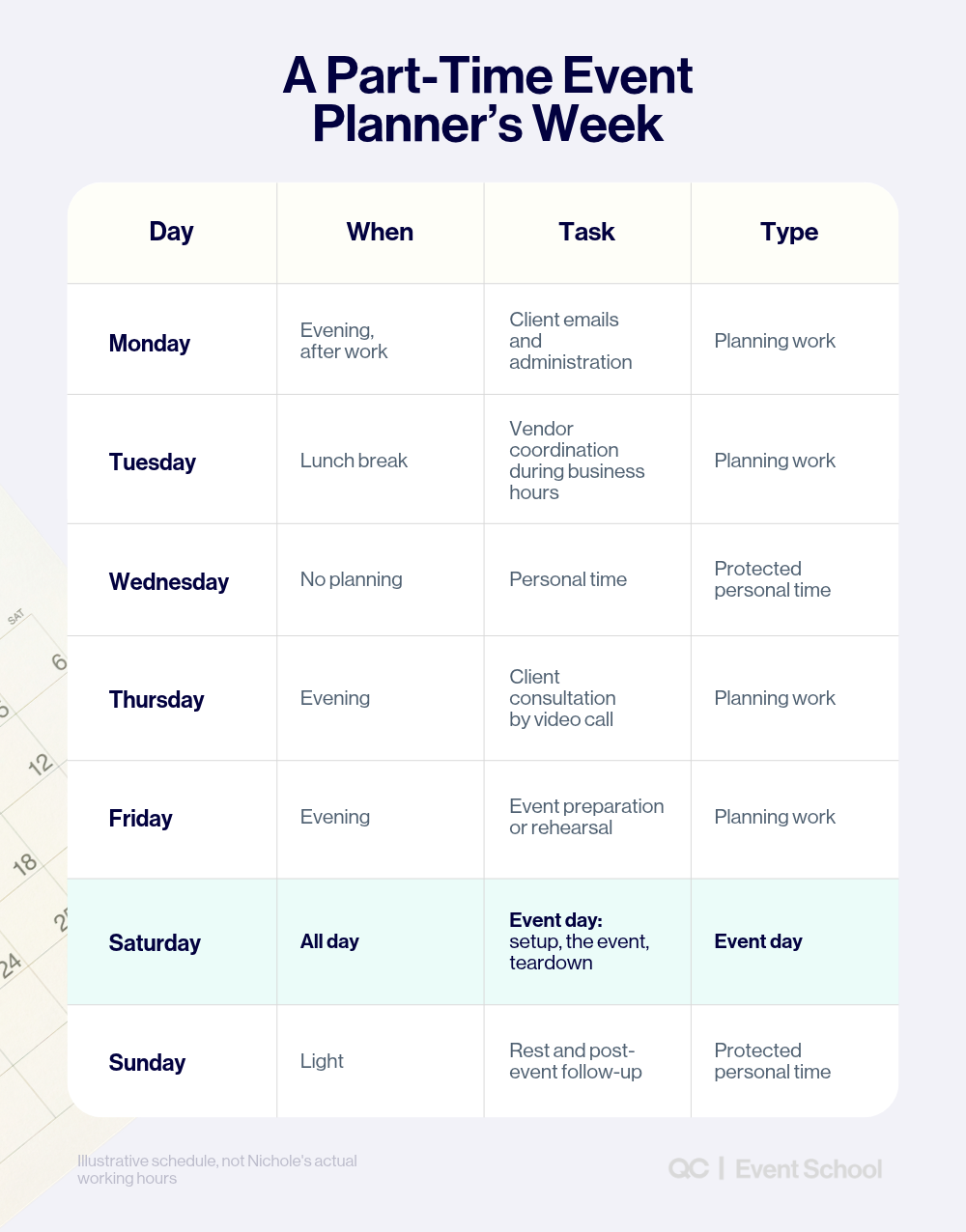
The sample schedule below illustrates how a planner might organize an event week around a regular full-time job.
Example: A part-time event planner’s week (illustrative schedule, not Nichole’s actual working hours).
| Day | When | Task | Type |
|---|---|---|---|
| Mon | Evening, after work | Client emails and administration | Planning work |
| Tue | Lunch break | Vendor coordination during business hours | Planning work |
| Wed | No planning | Personal time | Protected personal time |
| Thu | Evening | Client consultation by video call | Planning work |
| Fri | Evening | Event preparation or rehearsal | Planning work |
| Sat | All day | Event day: setup, the event, teardown | Event day |
| Sun | Light | Rest and post-event follow-up | Protected personal time |
Your own schedule will depend on your shifts, the services you offer and the event itself. Before launching, check your employment agreement for outside-work or conflict-of-interest clauses, particularly if your current job is in hospitality or events.
Nichole isn’t the only QC graduate who has combined another career with event planning. Jeanette Spencer, who started her event planning company alongside a full-time job, explained: “Doing online event planning courses enabled me to juggle my time efficiently and achieve my goals.”
How Much Can a Part-Time Event Planner Earn?
There is no single income figure for part-time event planners. Independent planners earn money from bookings, and their profit depends on services, local rates, expenses and hours worked. Employee salary figures don’t directly translate to freelance earnings.
The number of events you book is only part of the equation. A coordination package and a full-service planning package may bring in very different fees, but the more expensive service also requires more hours. Our guide to becoming a professional wedding planner explores service options and career paths.
Consider an illustrative example. Suppose you charge $1,500 for a wedding coordination booking and spend $300 on business expenses attributable to that event. That leaves $1,200 in profit before taxes.
If you spend 30 hours on consultations, emails, preparation, the wedding itself and follow-up, your effective hourly earnings are $40 before taxes. Counting only the event-day hours would give you a misleading picture.
These figures are hypothetical, not industry averages or Nichole’s rates. Your actual costs may include insurance, software, travel, marketing and assistant fees. Track both event-specific expenses and a reasonable share of ongoing business costs when assessing whether a service is profitable.
Nichole wishes she’d understood earlier how many hours go into emails, timelines and small decisions before an event, because “it matters when you’re setting your prices.” Make sure your fees account for this work, not just the event day itself. Set aside money for applicable taxes as well.
Can Part-Time Event Planning Become a Full-Time Career?
Yes. A part-time event planning business can grow into a full-time career, but making that move is optional. Some planners prefer a handful of bookings each year; others gradually expand their services as demand grows.
Before leaving another job, consider whether you have:
- ●Consistent bookings: Look for demand across more than one season, not just a busy summer.
- ●Sustainable pricing: Check that your fees cover the time and expenses of each event.
- ●Financial readiness: Review whether your business profit could support your living costs, with savings for quieter months, taxes and benefits you would lose.
If you’re regularly turning away suitable work because of your current schedule, consider whether reducing your hours at your existing job, hiring occasional event assistance or adjusting your services would help. You don’t necessarily need to jump straight from a few weekend bookings to running a full-time business.
Nichole is taking that transition at her own pace. Meraki celebrated its first anniversary in October 2026, and that same day she booked her first couple for 2028. She plans to focus on Meraki full-time when she retires from U.S. Steel. You can also keep planning part-time for as long as it suits your goals.

FAQs About Part-Time Event Planning
Can you become an event planner while working full-time?
Yes. You can complete professional training, gain hands-on experience and start accepting clients while maintaining your full-time job. QC Event School graduate Nichole Zeman launched Meraki Events & Designs LLC while continuing her career at U.S. Steel.
Can event planning be a side hustle?
Yes. Independent event planning allows you to choose your services, set your availability and control how many bookings you accept. Wedding coordination, private parties and freelance event assistance can be particularly suitable starting points.
Can I be an event planner on weekends only?
You can choose weekend events, but some services require weekday communication, rehearsals or site visits. If your weekday availability is limited, assisting an established planner on agreed event-day shifts may be a better fit.
Do part-time event planners need certification?
No. Event planning certification isn’t legally required in the U.S., and the BLS describes planner certifications as voluntary. Training still matters, because it shortens the trial-and-error stage and gives clients a reason to trust a new planner. Read more about event planning certification.
How many hours does a part-time event planner work?
There’s no industry-standard number. Hours depend on how many events you book and the scope of each service. A full-service wedding takes far more hours than day-of coordination, and work spikes in the weeks before each event. Track your own hours per event for your first few bookings to find your real capacity.
Start Your Event Planning Career at Your Own Pace
If you want to plan events without leaving your current job, start with training built around a working schedule. QC Event School’s Event & Wedding Planning course is fully online and self-paced, with up to a year to finish.
- ●Practical assignments based on real planning tasks, from budgets to vendor contracts to timelines
- ●Seven 1-on-1 reviews from tutors who are working event professionals
- ●Built-in business training covering marketing, vendor networking and building a styled-shoot portfolio
- ●Ready-to-use templates and contracts so you aren’t building paperwork from scratch
Ready to Become a Part-Time Event Planner?
Train online at your own pace with QC Event School’s Event & Wedding Planning course.
Graduates earn the International Event and Wedding Planning Professional (IEWP™) designation. Payment plans are available, and a 14-day money-back guarantee lets you review the materials first.
Sources
- U.S. Bureau of Labor Statistics, Occupational Outlook Handbook: Meeting, Convention, and Event Planners, last modified August 27, 2026
- QC Event School graduate testimonial and November 2026 questionnaire, Nichole Zeman (first-party data)
- QC Event School graduate testimonial, Jeanette Spencer (first-party data)